Bus Branding for Fintech & App Launches
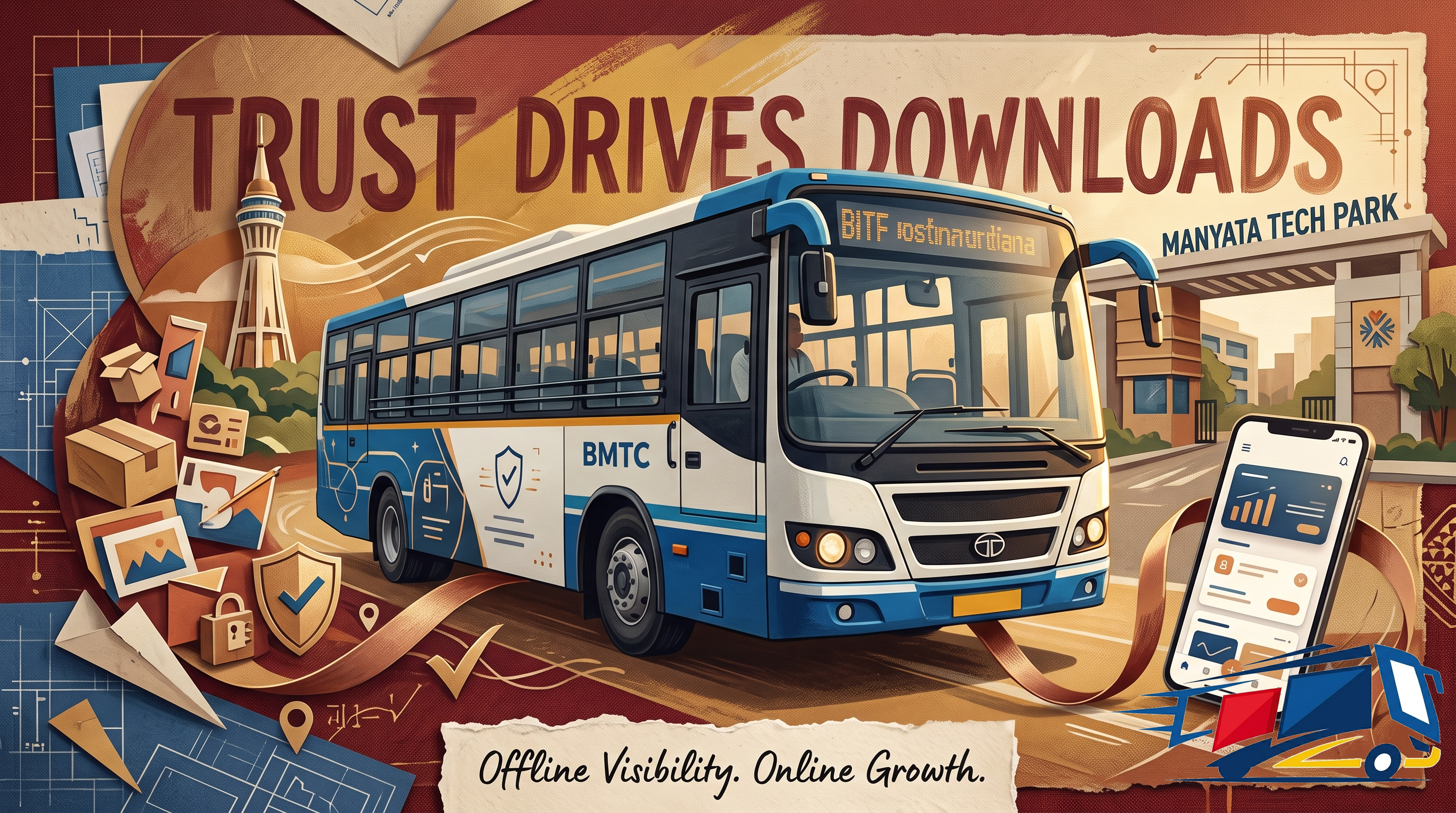
App growth teams live in dashboards: installs, CAC, LTV. So why put a brand on a bus? Because paid digital gets more expensive the harder you push it, and the thing that makes it cheaper is trust at scale. A bus does what a performance ad cannot: it makes your app a familiar, credible name across a whole city, so every paid click after that converts a little easier. Here is how offline awareness feeds online growth.
Key takeaways
- Brand lowers the trust tax: a strong brand makes every performance channel convert cheaper, easing the pressure on a rising CAC.
- Fintech's real barrier is trust: people are guarded about money apps, and a visible real-world brand signals legitimacy a banner cannot.
- Buses deliver awareness at scale: mass, unskippable, city-wide reach that performance ads, fighting for the same slots, cannot match.
- Bridge offline to install: a QR or vanity URL takes a viewer straight to the app store, the moment interest strikes.
- Route the tech audience: tech corridors, offices and dense urban areas reach the digitally active users most likely to adopt.
The CAC problem a bus actually solves
Every app marketer hits the same wall: paid channels get pricier as you scale, and acquisition cost creeps up. The fix is not only cheaper clicks, it is a stronger brand. A familiar name lowers the trust tax you pay in cold channels, so every performance rupee works harder. That is the unglamorous, real reason a bus belongs in a growth plan.
Source: fintech has among the highest customer acquisition costs of any category, and a strong brand lowers the trust tax paid in colder performance channels, making each paid dollar work harder; figures are international benchmarks, directional for India, 2026.
Trust is the real barrier, especially in fintech
For a money app, the hardest part is not getting noticed, it is getting trusted. People are guarded about apps that touch their money or data, and a digital-only brand can feel like it appeared from nowhere. A big, physical, city-wide presence signals something a banner never can: this is a real, established brand.
This is why even digital-first fintechs and neobanks put their brand on buses, billboards and the underground: the offline world lends credibility that the app store and the ad feed cannot manufacture. For a sceptical user deciding whether to trust you with their money, having seen your brand all over the city is a quiet but powerful reassurance.
Source: fintech users are among the most sceptical of any category, and trust is the primary conversion variable; major neobanks and fintechs use OOH including buses as the credibility-building awareness layer of an omnichannel mix, 2026.
Want your brand on Bengaluru's buses?
Get a route plan, format recommendation and pricing, usually within a minute.
Awareness at the scale a launch needs
An app launch needs to go from unknown to known fast, across a whole market. Performance ads reach people one by one, fighting for the same crowded slots. A fleet of branded buses blankets a city at once, unskippable and inescapable, which is exactly the broad, fast awareness a launch moment calls for.
| Digital alone | Adding buses |
|---|---|
| One user at a time | A whole city at once |
| Skippable, blockable | Unskippable, always on |
| Costs rise as you scale | Fixed cost, mass reach |
| In-feed, fleeting | In the real world, repeated |
Performance marketing is a sniper, precise, one target at a time, and pricier with every shot. A bus campaign is the weather: it changes the whole climate your app launches into, so every channel works better under it.
The offline-to-install bridge
The neat thing about an app is that the destination fits in a pocket. A bus can carry a QR code that takes a viewer straight to the app store, so the gap between seeing the brand and installing it is one scan. Build that bridge and the awareness becomes trackable, measurable installs.
Source: QR codes on OOH offer a low-friction path to app installs with scan to download prompts and device-aware deep links; clear value cues and attribution tagging make scans measurable, 2026.
An example launch campaign
Here is the approach made concrete for a fintech or app launching in a city. The structure is the takeaway, the routes, creative and reward would be set to your product.
| Layer | What runs | Job |
|---|---|---|
| Full wraps | Buses across tech corridors and the city | Mass awareness and brand trust |
| Back panels | QR / scan to download to the store | Bridge to a tracked install |
| Tech-corridor routes | [object Object] | Reach the digitally active audience |
| Interior cards | The one-line value prop, simply put | Explain the app to a captive rider |
- Lead with one clear idea. What the app does in a single line, the promise a stranger grasps instantly.
- Blanket the launch window. Heavy presence across the city in the launch period, so the brand feels everywhere.
- Weight to the tech audience. Corridors and offices full of the digitally active users likeliest to adopt.
- Bridge and attribute. A back-panel QR with a tracked deep link, so installs tie back to the buses.
We will be your offline awareness engine
Tell us your app, your launch city and your target user, and we will plan the route set that blankets the tech corridors and dense urban areas where your audience lives, wrapping the buses with your brand and a single clear promise, and carrying a scan to download QR with a deep link to your store listing. We brand the buses across your launch window and send daily GPS-tagged install photos. You watch the brand-search and install lift, and the way your paid channels start converting cheaper. We handle the buses.
Plan your launch under bus branding in Bengaluru, or see the wider approach in transit advertising.
Frequently Asked Questions
Why would a digital-first app use bus branding?+
Because brand lowers CAC. Paid channels get pricier as you scale, and a familiar, trusted brand makes every click convert cheaper. A bus builds that brand at city scale, so it feeds, rather than competes with, your performance marketing.
How does a bus help with trust?+
A big, repeated, real-world presence signals an established, legitimate brand, which matters most in fintech, where users are guarded about money and data. Seeing your name across the city reassures a sceptical user in a way a banner cannot.
Can a bus campaign drive app installs directly?+
Yes, via a QR bridge. A scan to download code on a back panel, with a device-aware deep link to the app store and attribution tags, turns a sighting into a tracked install, best placed where the bus pauses.
Which routes should an app launch use?+
Tech corridors, offices and dense urban areas, where the digitally active, early-adopting audience lives and commutes. For a city-wide launch, blanket broadly; for a niche app, weight to where its users concentrate.
How do I measure a bus campaign for an app?+
By brand-search lift, QR-driven installs, and a falling effective CAC on your paid channels during the campaign. The direct installs are the floor; the bigger effect is cheaper conversion everywhere else.
Is this only for big, funded apps?+
No. The reach scales to budget: a smaller app can concentrate buses in its core catchment or tech corridor rather than the whole city, getting the same brand-and-trust effect in the area that matters most.
Bus Branding Glossary
- Full bus branding (wrap)
- A full vehicle wrap covering both sides and the rear of the bus, the highest-impact, most visible format.
- Bus back / rear branding
- Advertising on the rear panel of the bus, in the line of sight of traffic queued behind it at signals and junctions.
- Side panel branding
- Branding on one or both side panels of the bus body, facing pedestrians and parallel traffic along the route.
- Vajra / AC service
- BMTC's premium air-conditioned (Volvo / Vayu Vajra) services, carrying a higher-income commuter set on IT and airport corridors.
- TTMC
- Traffic and Transit Management Centre, a large BMTC bus terminal where many routes start, terminate and interchange.
- Depot
- The BMTC facility where buses are parked, serviced and from which many local routes originate.
- Dwell time
- How long a bus stays in view of a stationary crowd, at a stop, signal or in slow traffic, which lengthens brand exposure.
- Corridor
- A main arterial road (e.g. the Outer Ring Road or Hosur Road) that a bus route runs along, defining who sees the branding.
How to run a BMTC bus branding campaign
Five simple steps from enquiry to a live, tracked campaign on Bengaluru's buses.
- 1
Pick your area & audience
Tell us the Bengaluru area or corridor you want to reach and who you're targeting, IT professionals, shoppers, students or residents.
- 2
Choose a format
Select a format, full bus wrap, rear panel, side panel or premium AC/Vajra service, based on your budget and the impact you want.
- 3
Select routes & bus count
We map the high-frequency routes and stops that cover your audience and recommend how many buses to brand.
- 4
Approve the creative
Share your artwork (or we help design it). We prepare it to BMTC specifications and get the approvals.
- 5
Go live & get proof
We print, wrap and deploy the buses, then share proof of display so you can see your brand on the road.
Bus Branding Formats
Choose how your brand rides, pick the format that fits your goal and budget.
Bus Branding Across Bengaluru
We run BMTC bus branding in every major Bengaluru neighbourhood. Explore more areas:
Outdoor & Transit Advertising Specialists
We plan, design and run BMTC bus branding campaigns across every major Bengaluru corridor, matching brands to the routes, formats and audiences that deliver the most visibility.
Discover More
Bus Branding for Telecom Brands
Why telecom and connectivity brands use bus branding: the mass reach a near-universal market needs, offer-led plan and 5G messaging, and the salience that wins the switch in a low-differentiation category.
Bus Branding for E-Commerce Brands
Why online retail and D2C brands use bus branding: an unskippable real-world break from the saturated feed, the recall paid ads cannot cheaply buy, a sale-event amplifier, and a QR bridge to the app.
Bus Branding for Automobile Dealerships
How bus branding drives showroom visits and test drives for car and bike dealers: reaching buyers on the road, winning the local visit, routing to the showroom, and timing to launches and festive buying.