Bus Branding for FMCG Product Launches
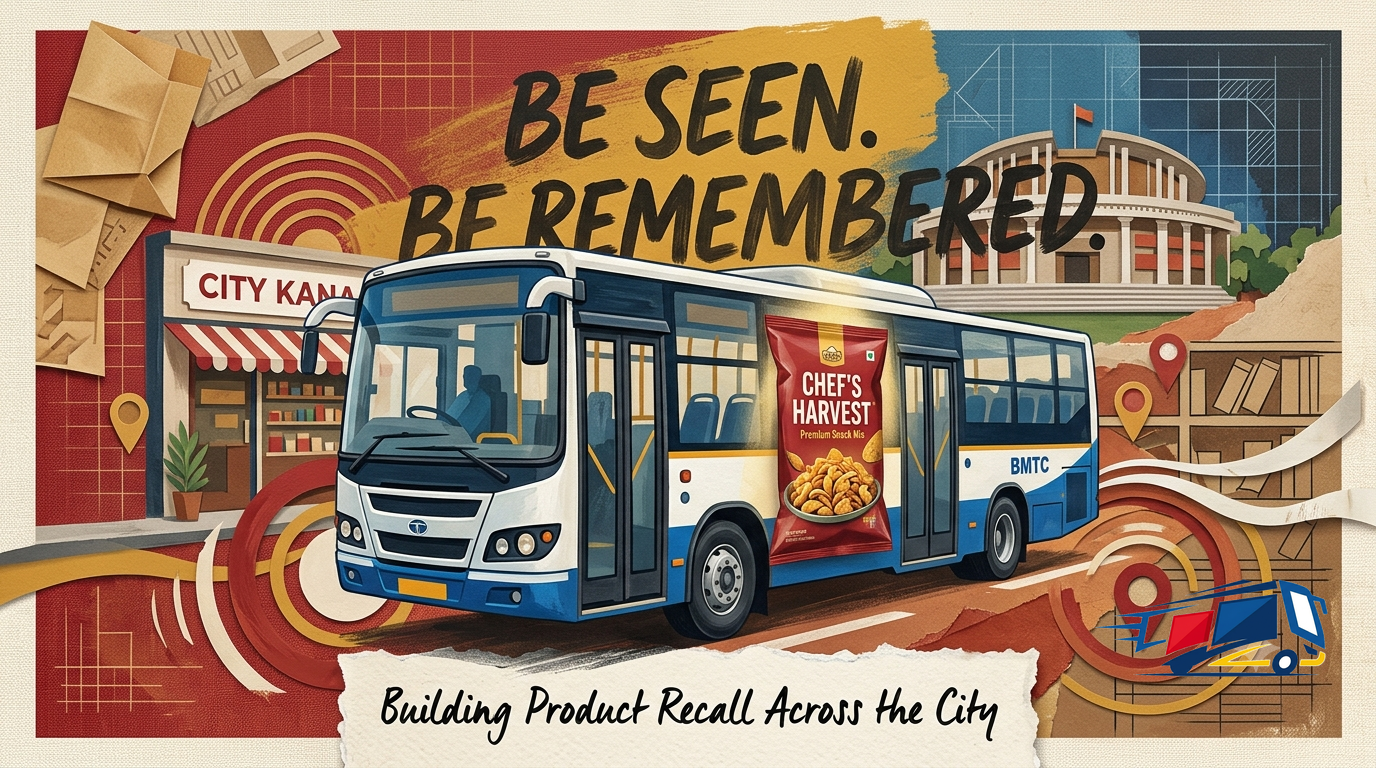
A new FMCG product wins or loses on one thing: whether enough people know it exists and reach for it at the shelf. The category runs on reach, repetition and recall, getting a new pack into millions of heads, cheaply, so it is the one picked among dozens. Bus branding fits because a fleet of buses saturates a city with your pack, again and again, until it feels familiar. Here is how transit launches a new SKU.
Key takeaways
- The goal is mental availability: a new SKU must be top of mind so it gets recalled and picked at the shelf or in the app.
- Reach times frequency: FMCG runs on broad reach and heavy repetition, exactly what a multi-bus fleet delivers across a city.
- Saturate, do not sprinkle: a launch needs the brand to feel everywhere, so a fleet beats a handful of buses.
- Make the pack the hero: bold, simple, pack-forward creative so the product is recognised the moment it is seen on sale.
- Sync with distribution: awareness should peak as the product hits shelves and quick-commerce, so demand meets availability.
The goal is mental availability
FMCG purchases are fast, frequent and barely considered. Standing at the shelf or scrolling a quick-commerce app, a shopper grabs the brand that comes to mind first. That is mental availability, and for a new SKU with none of it, the entire launch job is to build it: be known, be familiar, be the name that surfaces at the moment of choice.
A great product nobody has heard of loses to an average one everybody has. So a launch is a memory-building exercise before it is anything else, and the brands that win flood the market with consistent, repeated exposure until the new pack feels as familiar as the old favourites beside it.
Source: FMCG is a low-involvement, high-frequency category where purchase decisions favour the most mentally available brand; recall built through wide, repeated exposure drives selection at the point of purchase, 2026.
The fleet effect: reach times frequency
One bus is a sighting. A fleet is a presence. FMCG needs both halves of the equation, broad reach to be seen by enough people, and frequency to be seen enough times, and a multi-bus campaign delivers both at once as the buses crisscross the city all day, every day.
Source: FMCG advertising depends on reach and frequency to build recall; mass, repeated exposure across a market drives brand familiarity, which a multi-vehicle fleet provides cost-effectively, 2026.
For a new pack, frequency is not annoying, it is the whole point. The shopper does not buy what they saw once, they buy what they feel they have always known. A fleet of buses manufactures that feeling, one repeated sighting at a time.
Want your brand on Bengaluru's buses?
Get a route plan, format recommendation and pricing, usually within a minute.
Make the pack the hero
An FMCG bus has one job the shopper must complete later: recognise the pack on the shelf. So the creative is pack-forward, the product, big and bold, with the name and one simple idea. The bus should train the eye to spot your pack among a crowded row.
| Element | Why it matters |
|---|---|
| The pack, large | Trains recognition for the shelf |
| Brand name, clear | The thing to recall and ask for |
| One simple idea | A single benefit, grasped in seconds |
| Bold colour | Cuts through, aids memory |
| Category cue | Says instantly what it is |
Sync awareness with the shelves
In FMCG, availability equals visibility, the product has to be on the shelf when the demand arrives. So the awareness campaign should peak as distribution rolls out, so a shopper who saw the bus can actually find the pack. Awareness without availability wastes the spend; availability without awareness wastes the shelf.
| If distribution is | Run the buses |
|---|---|
| City-wide at launch | Full fleet across the whole city |
| Phased by zone | Concentrate routes in live zones first |
| Quick-commerce led | Dense urban routes, QR to the app |
| Kirana and modern trade | Broad routes through residential areas |
The buses can also reach the other audience a launch needs: retailers and stockists notice a brand that is visibly everywhere, and a product they see advertised at scale is one they believe will sell, which helps it earn shelf space in the first place.
An example launch campaign
Here is the approach made concrete for a new SKU launching in a city. The structure is the takeaway, the fleet size, pack and routes would be set to the product and budget.
| Layer | What runs | Job |
|---|---|---|
| Full wraps, fleet | [object Object] | Saturation and recall |
| Side panels | The pack and one idea, bold | Reinforce recognition |
| Back panels | QR to buy on quick-commerce | Bridge to an immediate order |
| Residential + arterial routes | Broad coverage where shoppers live | Reach the mass household audience |
- Lock the pack and one idea. The hero visual and single benefit, consistent across every bus.
- Size the fleet for saturation. Enough buses to feel everywhere, not a token few.
- Time it to distribution. Peak the buses as the product hits shelves and apps.
- Add a buy bridge. A back-panel QR to the quick-commerce listing, to capture immediate demand.
We will saturate the city with your new pack
Tell us your product, your launch city and your distribution plan, and we will size and route a bus fleet that blankets the market with your pack, pack-forward creative, bold and simple, repeated across enough buses to feel everywhere. We time the campaign to your shelf and quick-commerce rollout, can carry a QR to your listing, brand the buses across the launch window, and send daily GPS-tagged install photos. You watch recall and trial climb. We handle the buses.
Plan your launch under bus branding in Bengaluru, or see the wider approach in transit advertising.
Frequently Asked Questions
Why use bus branding for an FMCG launch?+
Because FMCG wins on reach, frequency and recall. A bus fleet saturates a city with repeated sightings of your pack, building the mental availability a new SKU needs to be recalled and picked at the shelf or in a quick-commerce app.
Why a fleet rather than a few buses?+
Because a launch needs to feel everywhere. A few buses are a sighting; a fleet is a presence that delivers both the broad reach and the heavy repetition that build recall. Saturation is the point.
What should the creative show?+
The pack, big and bold, with the name and one simple idea. The bus's job is to train shoppers to recognise your product on a crowded shelf, so distinctiveness beats a detailed feature list.
How does this connect to sales?+
By building recall that converts at the point of purchase, and by syncing with distribution so a shopper who saw the bus can find the pack. A back-panel QR to quick-commerce can also capture immediate trial.
When should the campaign run?+
Peaking as distribution rolls out, so awareness meets availability. Awareness without stock on the shelf is wasted, and stock without awareness sits unsold, so the two should rise together.
Does it work for a regional or smaller FMCG brand?+
Yes. A smaller brand can concentrate the fleet in its launch zone or city rather than going national, getting the same saturation effect in the market that matters, where its distribution is live.
Bus Branding Glossary
- Full bus branding (wrap)
- A full vehicle wrap covering both sides and the rear of the bus, the highest-impact, most visible format.
- Bus back / rear branding
- Advertising on the rear panel of the bus, in the line of sight of traffic queued behind it at signals and junctions.
- Side panel branding
- Branding on one or both side panels of the bus body, facing pedestrians and parallel traffic along the route.
- Vajra / AC service
- BMTC's premium air-conditioned (Volvo / Vayu Vajra) services, carrying a higher-income commuter set on IT and airport corridors.
- TTMC
- Traffic and Transit Management Centre, a large BMTC bus terminal where many routes start, terminate and interchange.
- Depot
- The BMTC facility where buses are parked, serviced and from which many local routes originate.
- Dwell time
- How long a bus stays in view of a stationary crowd, at a stop, signal or in slow traffic, which lengthens brand exposure.
- Corridor
- A main arterial road (e.g. the Outer Ring Road or Hosur Road) that a bus route runs along, defining who sees the branding.
How to run a BMTC bus branding campaign
Five simple steps from enquiry to a live, tracked campaign on Bengaluru's buses.
- 1
Pick your area & audience
Tell us the Bengaluru area or corridor you want to reach and who you're targeting, IT professionals, shoppers, students or residents.
- 2
Choose a format
Select a format, full bus wrap, rear panel, side panel or premium AC/Vajra service, based on your budget and the impact you want.
- 3
Select routes & bus count
We map the high-frequency routes and stops that cover your audience and recommend how many buses to brand.
- 4
Approve the creative
Share your artwork (or we help design it). We prepare it to BMTC specifications and get the approvals.
- 5
Go live & get proof
We print, wrap and deploy the buses, then share proof of display so you can see your brand on the road.
Bus Branding Formats
Choose how your brand rides, pick the format that fits your goal and budget.
Bus Branding Across Bengaluru
We run BMTC bus branding in every major Bengaluru neighbourhood. Explore more areas:
Outdoor & Transit Advertising Specialists
We plan, design and run BMTC bus branding campaigns across every major Bengaluru corridor, matching brands to the routes, formats and audiences that deliver the most visibility.
Discover More
Bus Branding for Telecom Brands
Why telecom and connectivity brands use bus branding: the mass reach a near-universal market needs, offer-led plan and 5G messaging, and the salience that wins the switch in a low-differentiation category.
Bus Branding for E-Commerce Brands
Why online retail and D2C brands use bus branding: an unskippable real-world break from the saturated feed, the recall paid ads cannot cheaply buy, a sale-event amplifier, and a QR bridge to the app.
Bus Branding for Automobile Dealerships
How bus branding drives showroom visits and test drives for car and bike dealers: reaching buyers on the road, winning the local visit, routing to the showroom, and timing to launches and festive buying.