Bus Branding for Public-Awareness & Government Campaigns
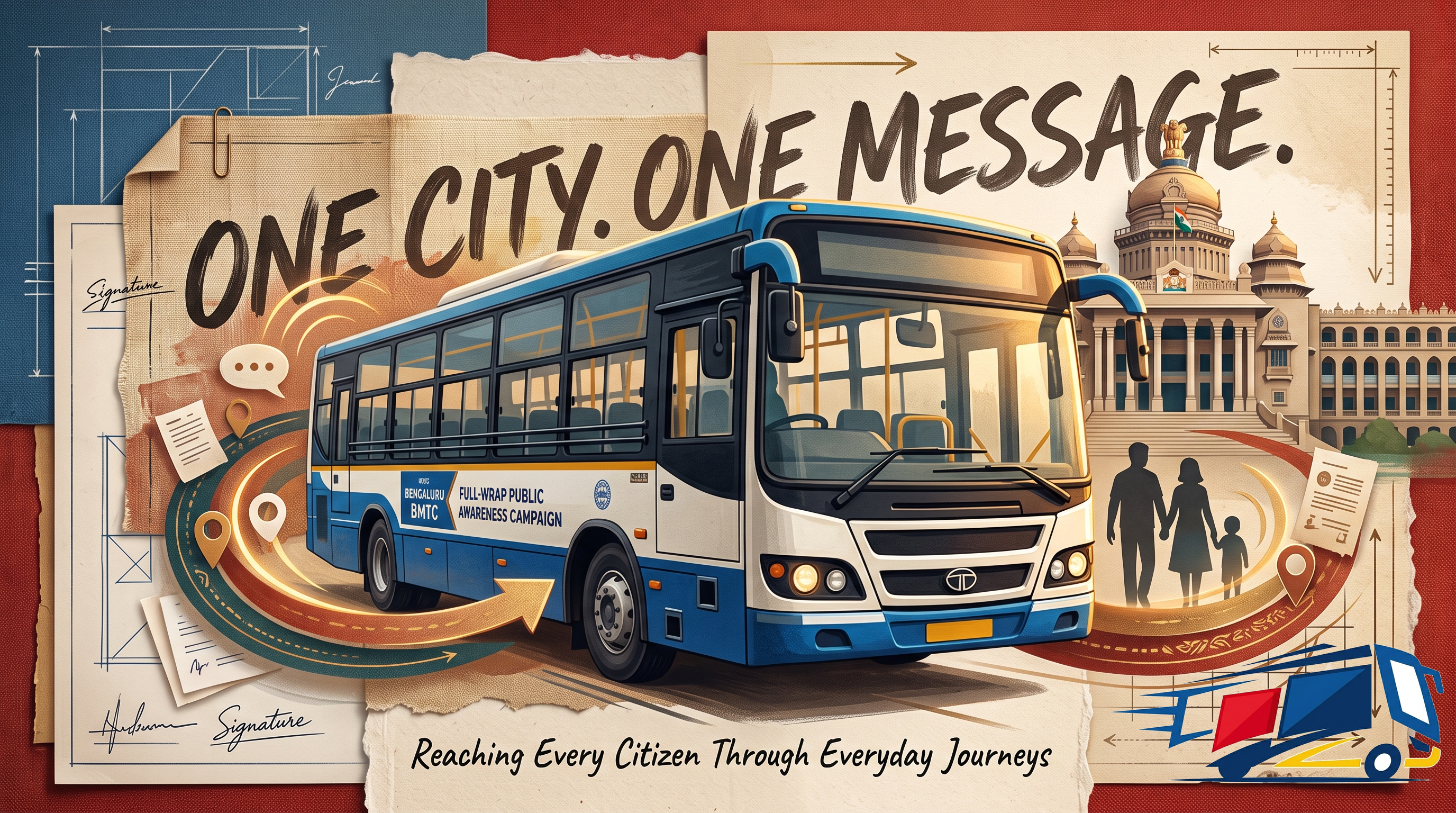
A public campaign has no customer, it has a whole population. The aim is not a sale but a message understood and acted on: know the helpline, take the vaccine, save the water, claim the scheme. That means reaching everyone, including the many who are not online. Bus branding fits public communication because it travels the whole city, in front of every kind of citizen, carrying a clear message in the local language. Here is how transit delivers a public message.
Key takeaways
- The audience is everyone: public campaigns target a whole population, not a buyer segment, so the medium has to reach all of society.
- Buses reach the offline majority: no smartphone or data needed, so the message lands with people digital channels miss.
- Use the local language: a clear message in the city's own language is understood and trusted across communities.
- Keep it to one idea: a single, simple, memorable message, a helpline, a date, a behaviour, travels and sticks.
- It is one layer of many: behaviour change needs an integrated push; the bus is the visible, repeated mass-reach part of it.
The audience is everyone
Commercial advertising chases a target segment. A public campaign is the opposite: the message is for the whole population, the young and old, rich and poor, every neighbourhood and community. The medium therefore has to be broad and indiscriminate by design, in front of all of society, not just a profitable slice of it.
A bus moving through the city all day is seen by exactly this universal cross-section: people at bus stops, on the road, in markets, on their own commute. For a message that everyone needs to receive, that indiscriminate, all-of-society reach is the point, not a limitation.
Source: public service campaigns aim to reach an entire population to shift knowledge, attitudes and behaviour; they are a long-standing instrument for communicating directly with millions across a diverse nation, 2026.
Reaching the people digital misses
A digital-only public campaign quietly excludes the people who often need the message most: those without a smartphone, without data, or who simply are not on the platforms. A bus needs none of that. It reaches the offline majority in the physical world, which is why mass public drives still lean heavily on outdoor and on-ground media.
This is why landmark public campaigns deploy every channel at once, hoardings, vans, wall paintings, on-ground outreach and transit alongside TV and digital, so no community is left out. The bus is the part of that mix that puts the message physically in front of the people a screen never reaches.
Source: major Indian public campaigns use an all-channel approach including outdoor, mobile vans and on-ground media precisely to reach communities beyond digital, recognising different communities need reaching in different ways, 2026.
Want your brand on Bengaluru's buses?
Get a route plan, format recommendation and pricing, usually within a minute.
One clear message that travels
A bus has seconds of a stranger's attention, so a public message must be one idea, simply put. The campaigns that stick reduce a complex issue to a single memorable line and one action, and then repeat it everywhere until it is common knowledge.
| Type | Example of the ask |
|---|---|
| A behaviour | Wear a helmet, save water, segregate waste |
| A helpline / number | Call this number for help |
| A scheme / right | You are eligible, here is how to claim |
| A date / event | Vaccination day, last date to register |
| A warning | Don't drink and drive, beware this fraud |
A public campaign does not need to be clever, it needs to be everywhere and unmistakable. One message, one action, in the language people think in, repeated on enough buses to become something the whole city simply knows.
Local language and civic credibility
Two things make a public message land: that people can read it in their own language, and that it feels trustworthy. A bus serves both. India's campaigns run in many languages for a reason, and a message in the local tongue reaches communities a national-language ad does not. A public vehicle also lends a civic, official feel that aids belief.
| Need | How the bus serves it |
|---|---|
| Be understood | Carry the message in the local language |
| Be believed | A public medium feels official, not salesy |
| Reach communities | Route to the areas a message must reach |
| Be seen often | Daily repetition builds recall |
An example public-awareness campaign
Here is the approach made concrete for a citywide awareness drive, say a health, safety or civic-scheme message. The structure is the takeaway, the message, language and routes would be set to the campaign and its goal.
| Layer | What runs | Job |
|---|---|---|
| Full wraps / side panels | One message, local language, citywide | Mass, all-society reach |
| Back panels | The helpline, date or QR to act | Turn awareness into the action |
| Interior cards | A little more detail for riders | Explain the scheme or behaviour |
| Targeted routes | Areas the message most needs to reach | Reach the priority communities |
- Reduce to one idea. The single message and the one action you want people to take.
- Put it in the local language. So every community along the route can read and trust it.
- Route for full coverage. Citywide for a universal message, weighted to priority areas where needed.
- Give a way to act. A helpline, a date, a QR, so awareness can become the behaviour.
We will carry your message across the city
Tell us your message, the communities you need to reach and the languages they speak, and we will plan the route set that puts it in front of the whole public, the markets, the residential areas, the corridors a city moves through, in clear local-language creative with a helpline, date or QR to act on. We brand the buses across the campaign window and send daily GPS-tagged install photos so you have a record of coverage. You drive the awareness and the outcome. We handle the buses. For a behaviour-change goal, the buses work best as the mass-reach layer of your wider, multi-channel effort.
Plan your awareness campaign under bus branding in Bengaluru, or see the wider approach in transit advertising.
Frequently Asked Questions
Why use buses for a public-awareness campaign?+
Because the audience is the whole public, and a bus reaches all of society, every age, income and area, including the people not online. It carries a clear message in the local language across the city, with the civic feel of a public medium.
How do buses reach people digital cannot?+
They work in the physical world, needing no smartphone or data. People at stops, on the road and in markets see the message regardless of whether they use social media, which is why mass public drives rely on outdoor and on-ground media.
What should a public-awareness bus say?+
One idea, one action. A behaviour to adopt, a helpline to call, a scheme to claim, a date to remember. Reduce the issue to a single memorable line and repeat it widely; clarity beats cleverness.
Does language matter?+
A great deal. Running the message in the local language of each area means every community can read and trust it. Indian public campaigns are delivered in many languages precisely so no group is left out.
Can a bus campaign change behaviour on its own?+
It builds awareness and recall at scale, which is the foundation, but lasting behaviour change usually needs an integrated effort across channels and on-ground work. The bus is the powerful mass-reach layer, not the whole campaign.
How is a public campaign measured?+
By reach, message recall, and the behaviour or response, calls to a helpline, scheme registrations, attendance on a date, survey-measured awareness shifts. A QR or dedicated number on the buses ties response back to the campaign.
Bus Branding Glossary
- Full bus branding (wrap)
- A full vehicle wrap covering both sides and the rear of the bus, the highest-impact, most visible format.
- Bus back / rear branding
- Advertising on the rear panel of the bus, in the line of sight of traffic queued behind it at signals and junctions.
- Side panel branding
- Branding on one or both side panels of the bus body, facing pedestrians and parallel traffic along the route.
- Vajra / AC service
- BMTC's premium air-conditioned (Volvo / Vayu Vajra) services, carrying a higher-income commuter set on IT and airport corridors.
- TTMC
- Traffic and Transit Management Centre, a large BMTC bus terminal where many routes start, terminate and interchange.
- Depot
- The BMTC facility where buses are parked, serviced and from which many local routes originate.
- Dwell time
- How long a bus stays in view of a stationary crowd, at a stop, signal or in slow traffic, which lengthens brand exposure.
- Corridor
- A main arterial road (e.g. the Outer Ring Road or Hosur Road) that a bus route runs along, defining who sees the branding.
How to run a BMTC bus branding campaign
Five simple steps from enquiry to a live, tracked campaign on Bengaluru's buses.
- 1
Pick your area & audience
Tell us the Bengaluru area or corridor you want to reach and who you're targeting, IT professionals, shoppers, students or residents.
- 2
Choose a format
Select a format, full bus wrap, rear panel, side panel or premium AC/Vajra service, based on your budget and the impact you want.
- 3
Select routes & bus count
We map the high-frequency routes and stops that cover your audience and recommend how many buses to brand.
- 4
Approve the creative
Share your artwork (or we help design it). We prepare it to BMTC specifications and get the approvals.
- 5
Go live & get proof
We print, wrap and deploy the buses, then share proof of display so you can see your brand on the road.
Bus Branding Formats
Choose how your brand rides, pick the format that fits your goal and budget.
Bus Branding Across Bengaluru
We run BMTC bus branding in every major Bengaluru neighbourhood. Explore more areas:
Outdoor & Transit Advertising Specialists
We plan, design and run BMTC bus branding campaigns across every major Bengaluru corridor, matching brands to the routes, formats and audiences that deliver the most visibility.
Discover More
Bus Branding for Telecom Brands
Why telecom and connectivity brands use bus branding: the mass reach a near-universal market needs, offer-led plan and 5G messaging, and the salience that wins the switch in a low-differentiation category.
Bus Branding for E-Commerce Brands
Why online retail and D2C brands use bus branding: an unskippable real-world break from the saturated feed, the recall paid ads cannot cheaply buy, a sale-event amplifier, and a QR bridge to the app.
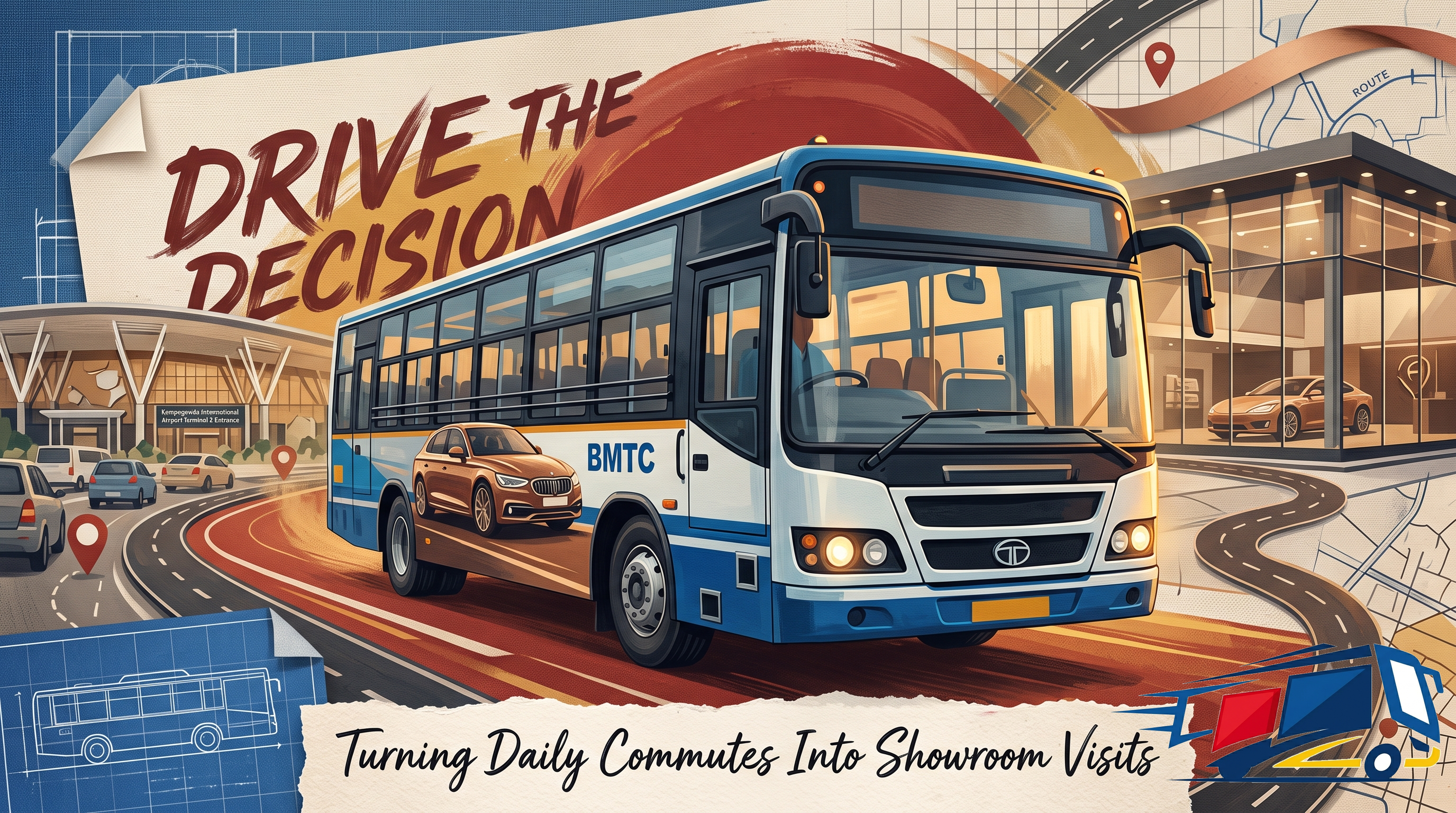
Bus Branding for Automobile Dealerships
How bus branding drives showroom visits and test drives for car and bike dealers: reaching buyers on the road, winning the local visit, routing to the showroom, and timing to launches and festive buying.