Bus Branding for Real Estate Developers
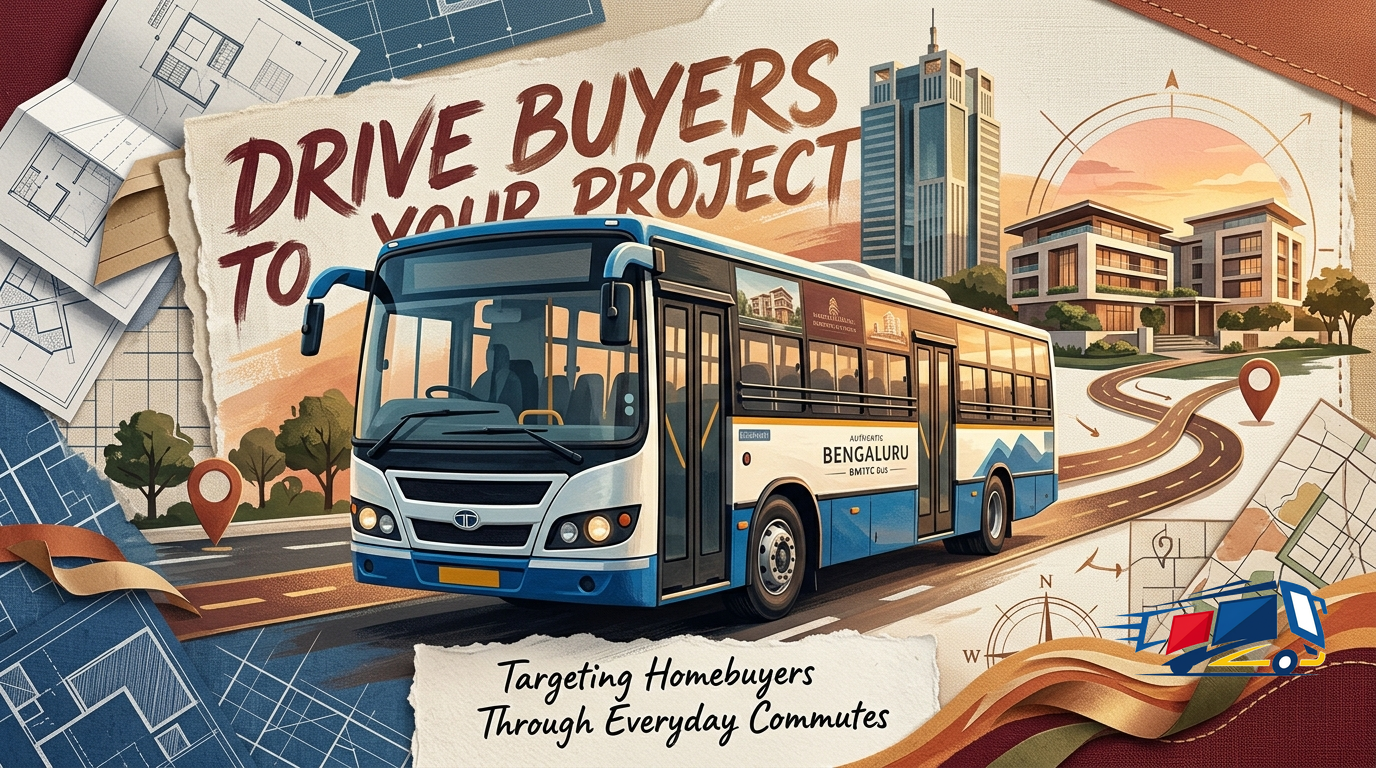
A property launch is not a brand campaign with no end date. It has finite inventory and a compressed sales window, and it is judged on one thing: site visits that turn into bookings. Bus branding earns its place here by doing what a launch needs most, putting the project in front of the exact buyers who live and work around it, day after day, until they visit. Here is how transit fits a developer's playbook.
Key takeaways
- Launches are footfall machines: the goal is site visits and sales velocity in a short window, not vague awareness.
- Buyers think in micro-markets: most purchase within a commute radius, exactly the area a bus route covers.
- Route targeting is the fit: brand the corridors your target buyers travel daily near the project and its feeders.
- Repetition builds the trust to visit: seen every morning for weeks, a project becomes familiar, then credible, then a visit.
- Transit anchors the launch mix: outdoor and transit often take the largest slice of a launch budget.
Why buses suit a launch
A launch has a clock on it. Inventory is fixed, the sales window is short, and a buyer's decision takes weeks of consideration laced with anxiety about RERA, possession dates and carpet area. Bus branding fits because it does sustained, repeated, local work over exactly that window.
A buyer who sees your project on the bus every morning for a month does not just remember the name, they start to trust it. In a category where trust is the real barrier to a site visit, that repeated, visible presence is the work. The bus is the steady drumbeat under the launch.
Source: property launches have finite inventory and compressed sales windows judged on sales velocity; OOH and transit build the familiarity and trust that move buyers toward a visit over a multi-week consideration period, 2026.
Route targeting around the project
This is the heart of it. Real estate buyers purchase within a micro-market, usually within a comfortable commute of work or family. A bus route maps onto that micro-market precisely: choose the routes that thread the project's catchment and the corridors your buyers travel, and the campaign lands on exactly the right people.
| Target buyer | Routes to brand |
|---|---|
| Local upgraders | Routes through the project's own micro-market |
| Nearby tech workers | Office-corridor routes feeding the area |
| Investors from across town | Key arterial routes into the zone |
| Families seeking schools | [object Object] |
Want your brand on Bengaluru's buses?
Get a route plan, format recommendation and pricing, usually within a minute.
Formats that work for property
A property message has more to carry than a slogan: the project name, the configuration, the location pull, a possession promise, a way to respond. Different transit formats handle different parts of that job, so match the format to what the buyer needs at each moment.
| Format | Strength | Best for |
|---|---|---|
| Full wrap / side panel | Travels the neighbourhoods | Project awareness across the catchment |
| Back panel | Read at signals, room for a QR | Site-visit CTA, scan to book |
| [object Object] | High dwell, right by the project | Detail and directions to the site |
| Interior cards | Captive, longer message | Configurations, possession, RERA note |
| [object Object] | Premium, traveller reach | NRI and luxury project buyers |
A hoarding sits and waits for buyers to pass it. A branded bus drives into the neighbourhoods your buyers live in, every day of the launch. For a project rooted in one micro-market, that is the difference between hoping to be seen and choosing to be seen.
Where transit fits the launch mix
Transit is not the whole plan, it is the awareness and trust layer that feeds the rest. A common launch split puts the largest share on outdoor and transit, then digital to capture intent, then print and experiential for credibility. The bus warms the micro-market so the digital and the sales gallery convert.
Source: a common property-launch budget model allocates roughly 40% to outdoor and transit, 30% to digital, 30% to print and experiential; ratios shift by project type and audience. Developers often spend ~2 to 5% of development value on marketing, concentrated at launch. Illustrative benchmarks, 2026.
The handoff is the point. The bus and shelter build recognition across the micro-market; geo-targeted digital retargets the people who saw them; the sales gallery and print close. One launch, one message, transit doing the heavy lifting on familiarity.
An example launch campaign
Here is the approach made concrete for a project launching in one Bengaluru micro-market. The structure is the takeaway, the numbers would be set to the project.
| Layer | What runs | Job |
|---|---|---|
| Wraps / side panels | Buses on the catchment's routes | Project awareness in the micro-market |
| Back panels | QR to a site-visit booking page | Turn awareness into a booked visit |
| Shelter near site | Panels at stops by the project | Detail and directions for the close-by |
| Interior cards | Configs, possession, RERA number | Answer the buyer's real questions |
- Define the catchment. The micro-market and the feeder corridors your buyers commute.
- Brand the routes through it. Wraps and side panels for awareness across that zone.
- Add a response layer. Back-panel QR and interior cards pointing to a site-visit booking page.
- Run it through the window. Sustained presence across the launch, so the project becomes the familiar name.
We will build the transit layer of your launch
Tell us the project, the micro-market and the buyer, and we will plan the route set that rings your site and rides your buyers' commute, in the formats that carry a property message: wraps for awareness, back panels with a booking QR, shelter near the site, interior cards for the detail. We brand the buses across your launch window, send daily GPS-tagged install photos, and point everything at your site-visit page. You measure it in walk-ins. We handle the buses.
Plan your launch campaign under bus branding in Bengaluru, or see the wider approach in transit advertising.
Frequently Asked Questions
Why use bus branding for a property launch?+
Because a launch needs site visits in a short window, and buses deliver sustained, repeated, local exposure to the exact catchment around the project, building the familiarity and trust that move a buyer to book a visit.
How does route targeting help a developer?+
Buyers purchase within a micro-market and commute radius. Choosing routes that ring the project and carry its likely buyers puts the campaign on exactly the right people, rather than scattering spend citywide.
Which transit formats suit real estate?+
Wraps and side panels for awareness across neighbourhoods, back panels for a scan-to-book CTA at signals, shelter near the site for detail and directions, interior cards for configurations and RERA detail, and airport routes for NRI or luxury buyers.
How much of a launch budget goes to transit?+
Often the largest single slice. A common model is roughly 40% outdoor and transit, 30% digital, 30% print and experiential, with developers spending around 2 to 5% of development value on marketing, concentrated at launch. Ratios shift by project.
Does bus branding drive actual site visits?+
Indirectly but measurably. The bus builds recognition; pair it with a back-panel QR to a booking page and you can track visits booked. OOH real estate cases report meaningful walk-in lifts, so judge it alongside footfall, not impressions alone.
How long should a launch campaign run?+
Across the active sales window. Real estate decisions take weeks, so sustained presence through the consideration period is what builds the trust to visit, a short burst rarely does.
Bus Branding Glossary
- Full bus branding (wrap)
- A full vehicle wrap covering both sides and the rear of the bus, the highest-impact, most visible format.
- Bus back / rear branding
- Advertising on the rear panel of the bus, in the line of sight of traffic queued behind it at signals and junctions.
- Side panel branding
- Branding on one or both side panels of the bus body, facing pedestrians and parallel traffic along the route.
- Vajra / AC service
- BMTC's premium air-conditioned (Volvo / Vayu Vajra) services, carrying a higher-income commuter set on IT and airport corridors.
- TTMC
- Traffic and Transit Management Centre, a large BMTC bus terminal where many routes start, terminate and interchange.
- Depot
- The BMTC facility where buses are parked, serviced and from which many local routes originate.
- Dwell time
- How long a bus stays in view of a stationary crowd, at a stop, signal or in slow traffic, which lengthens brand exposure.
- Corridor
- A main arterial road (e.g. the Outer Ring Road or Hosur Road) that a bus route runs along, defining who sees the branding.
How to run a BMTC bus branding campaign
Five simple steps from enquiry to a live, tracked campaign on Bengaluru's buses.
- 1
Pick your area & audience
Tell us the Bengaluru area or corridor you want to reach and who you're targeting, IT professionals, shoppers, students or residents.
- 2
Choose a format
Select a format, full bus wrap, rear panel, side panel or premium AC/Vajra service, based on your budget and the impact you want.
- 3
Select routes & bus count
We map the high-frequency routes and stops that cover your audience and recommend how many buses to brand.
- 4
Approve the creative
Share your artwork (or we help design it). We prepare it to BMTC specifications and get the approvals.
- 5
Go live & get proof
We print, wrap and deploy the buses, then share proof of display so you can see your brand on the road.
Bus Branding Formats
Choose how your brand rides, pick the format that fits your goal and budget.
Bus Branding Across Bengaluru
We run BMTC bus branding in every major Bengaluru neighbourhood. Explore more areas:
Outdoor & Transit Advertising Specialists
We plan, design and run BMTC bus branding campaigns across every major Bengaluru corridor, matching brands to the routes, formats and audiences that deliver the most visibility.
Discover More
Bus Branding for Telecom Brands
Why telecom and connectivity brands use bus branding: the mass reach a near-universal market needs, offer-led plan and 5G messaging, and the salience that wins the switch in a low-differentiation category.
Bus Branding for E-Commerce Brands
Why online retail and D2C brands use bus branding: an unskippable real-world break from the saturated feed, the recall paid ads cannot cheaply buy, a sale-event amplifier, and a QR bridge to the app.
Bus Branding for Automobile Dealerships
How bus branding drives showroom visits and test drives for car and bike dealers: reaching buyers on the road, winning the local visit, routing to the showroom, and timing to launches and festive buying.