Bus Branding for Retail & Shopping Malls
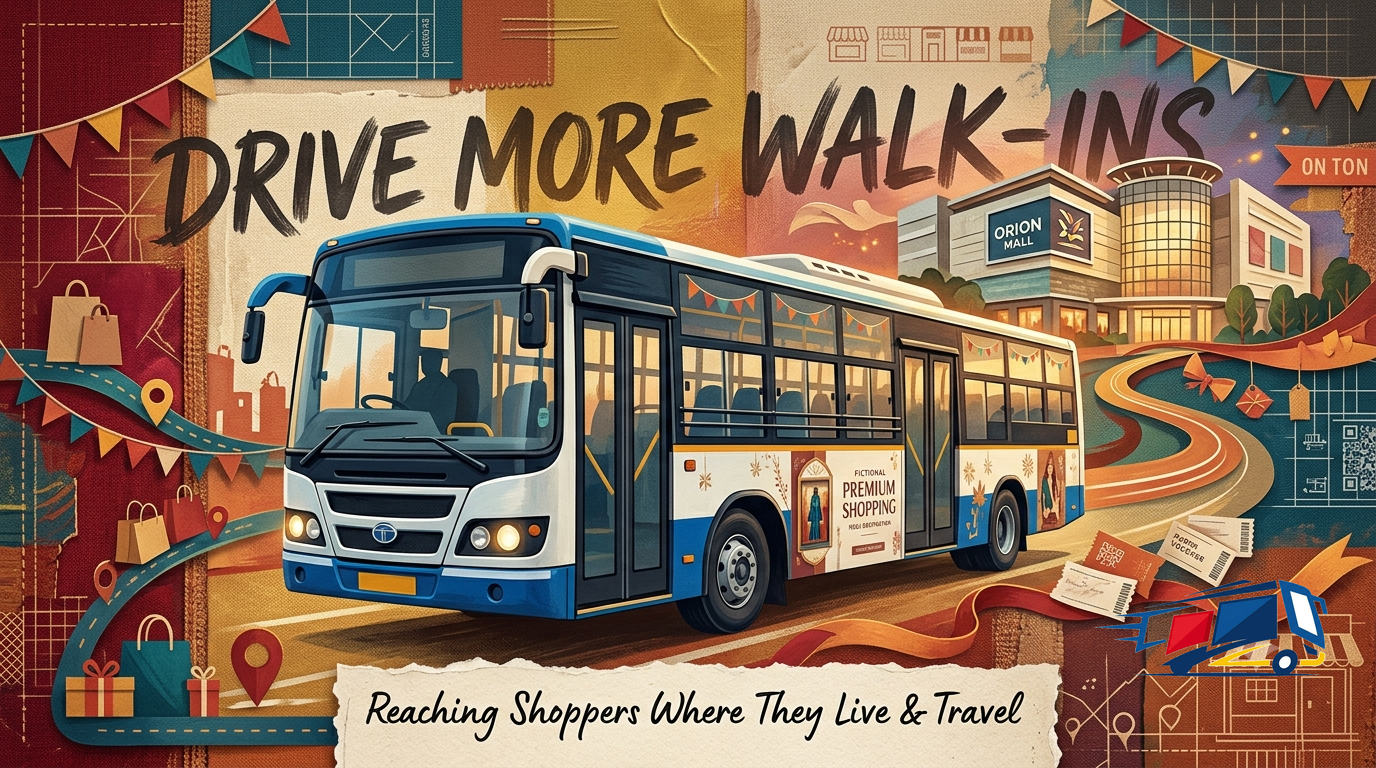
Retail has one honest scoreboard: footfall. A store or mall wins when more of the right people walk through the door, and it wins most when an offer and a moment line up. Bus branding suits retail because it does three things the category needs: it travels the catchment your shoppers live in, it can carry an offer, and it can be timed to the weekends and festivals when people are already out to spend. Here is how transit drives store visits.
Key takeaways
- Footfall is the goal: the job is to convert on the move into in the store, so proximity and a reason to visit matter most.
- Route the feeders: brand the buses that travel the residential catchment and the corridors leading to your store or mall.
- Go offer-led: unlike some categories, retail can advertise a sale, a new collection or a festive deal, which drives immediate action.
- Time it to the peaks: footfall spikes at weekends and during festive season, so weight the campaign to when people are out to spend.
- Make it trackable: a QR or voucher on a back panel ties bus exposure to redemptions and walk-ins.
Footfall is the whole game
Retail does not need awareness for its own sake, it needs people through the door. The bus earns its place by turning proximity into a prompt: it reminds shoppers who are already nearby and already in a buying frame of mind that you exist, you are close, and there is a reason to come in now.
An ad seen on the daily route works on a shopper differently from one seen online: it sits in the real world, near where they actually shop, nudging a store visit at the moment they are out and about. That nearness is why transit is so well suited to driving walk-ins rather than just impressions.
Source: OOH near shopping districts and commuter routes reminds nearby consumers of a brand's presence and drives footfall, turning real-world proximity into store visits, 2026.
Route the buses that feed your store
The targeting logic for retail is simple: brand the routes that physically bring shoppers to you. That means the residential catchment your customers come from and the corridors that lead to the store or mall entrance. The bus becomes a moving sign on the road to your door.
| Goal | Routes to brand |
|---|---|
| Pull the local catchment | Residential routes around the store |
| Capture passing traffic | Routes along the corridor to the mall |
| Reach the wider draw | Arterial routes feeding the shopping district |
| Multi-store chain | Routes around each outlet's neighbourhood |
Want your brand on Bengaluru's buses?
Get a route plan, format recommendation and pricing, usually within a minute.
Lead with an offer
Here is where retail has an advantage over more restricted categories: it can put a deal on the bus. A clear offer is the strongest reason to walk in today, so retail creative should be bold, simple, and built around a tempting, time-bound message rather than a soft brand line.
| Message type | What it does |
|---|---|
| Sale / discount | A direct reason to visit now |
| New collection / arrival | Novelty pulls the curious in |
| Festive offer | Rides the season's spending mood |
| New store opening | Announces a reason to come see |
| Limited-time deal | Urgency drives an immediate trip |
In retail the bus is not a billboard, it is a moving shop window with a deal on it, driving past your customers on the very roads that lead back to your door. Give them an offer and a reason to turn in today.
Timing the campaign to the peaks
Retail demand is not flat across the year, it surges. Weekends pull more shoppers than weekdays, and the festive season lifts footfall across malls and high streets sharply. A bus campaign that is loudest when people are already out to spend works far harder than one running evenly.
Source: footfall across malls and high streets rises sharply in festive seasons and at weekends, with elevated purchase intent; campaigns timed to these windows capture more store visits, 2026. Illustrative pattern.
An example retail campaign
Here is the approach made concrete for a store or mall driving festive footfall. The structure is the takeaway, the routes, offer and dates would be set to your outlet and calendar.
| Layer | What runs | Job |
|---|---|---|
| Wraps / side panels | Buses on the catchment and corridor routes | Carry the offer across the area |
| Back panels | QR / voucher code to redeem in store | Turn the offer into a tracked visit |
| Routes past the mall | Buses along the entrance corridor | Catch shoppers minutes from the door |
| Festive burst | Heavier weight through the season | Peak when footfall and intent peak |
- Map the feeder routes. The catchment and the corridors that lead to your store or mall.
- Put the offer on the bus. Bold, simple, time-bound, the reason to visit today.
- Weight to the peaks. Heavier through weekends and the festive surge, lighter in the lulls.
- Track the redemptions. A QR or code on the back panel, tied to in-store use, to count the walk-ins.
We will drive footfall to your door
Tell us your store or mall, your catchment and your offer, and we will plan the route set that travels the neighbourhoods your shoppers live in and the corridors that lead to your entrance, carrying a bold, time-bound offer with a QR or voucher code to redeem in store. We weight the buses to weekends and the festive surge, brand them across the campaign, and send daily GPS-tagged install photos. You count the walk-ins and redemptions. We handle the buses.
Plan your footfall campaign under bus branding in Bengaluru, or see the wider approach in transit advertising.
Frequently Asked Questions
Why use bus branding for a store or mall?+
Because retail runs on footfall, and a bus turns proximity into a prompt: it reminds nearby shoppers, already in a buying mood, that you are close and have a reason to visit, nudging a store visit in the real world.
Which routes should a retailer pick?+
The routes that feed your store: the residential catchment your customers come from and the corridors leading to the entrance. The closer the route, the warmer the visit, so prioritise the buses nearest the store.
Can a bus advertise an offer or sale?+
Yes, and it should. Retail can run offer-led creative, a sale, new collection, festive deal or limited-time discount, which gives shoppers a direct, time-bound reason to walk in today, far stronger than a soft brand line.
When should a retail campaign run?+
Weighted to the peaks: weekends and the festive season, when footfall and purchase intent surge. Launch in the run-up and run loudest through the season, rather than spreading spend evenly across quiet months.
How do I measure footfall from a bus campaign?+
Put a QR or voucher code on the back panel that is redeemed in store. Track redemptions and tie them to the campaign window, and watch overall walk-in and sales lift during the run versus a quiet period.
Does this work for a multi-store chain?+
Yes. Stack routes per outlet so each store's own neighbourhood sees the buses and offer, making every location locally visible and driving walk-ins to the nearest one.
Bus Branding Glossary
- Full bus branding (wrap)
- A full vehicle wrap covering both sides and the rear of the bus, the highest-impact, most visible format.
- Bus back / rear branding
- Advertising on the rear panel of the bus, in the line of sight of traffic queued behind it at signals and junctions.
- Side panel branding
- Branding on one or both side panels of the bus body, facing pedestrians and parallel traffic along the route.
- Vajra / AC service
- BMTC's premium air-conditioned (Volvo / Vayu Vajra) services, carrying a higher-income commuter set on IT and airport corridors.
- TTMC
- Traffic and Transit Management Centre, a large BMTC bus terminal where many routes start, terminate and interchange.
- Depot
- The BMTC facility where buses are parked, serviced and from which many local routes originate.
- Dwell time
- How long a bus stays in view of a stationary crowd, at a stop, signal or in slow traffic, which lengthens brand exposure.
- Corridor
- A main arterial road (e.g. the Outer Ring Road or Hosur Road) that a bus route runs along, defining who sees the branding.
How to run a BMTC bus branding campaign
Five simple steps from enquiry to a live, tracked campaign on Bengaluru's buses.
- 1
Pick your area & audience
Tell us the Bengaluru area or corridor you want to reach and who you're targeting, IT professionals, shoppers, students or residents.
- 2
Choose a format
Select a format, full bus wrap, rear panel, side panel or premium AC/Vajra service, based on your budget and the impact you want.
- 3
Select routes & bus count
We map the high-frequency routes and stops that cover your audience and recommend how many buses to brand.
- 4
Approve the creative
Share your artwork (or we help design it). We prepare it to BMTC specifications and get the approvals.
- 5
Go live & get proof
We print, wrap and deploy the buses, then share proof of display so you can see your brand on the road.
Bus Branding Formats
Choose how your brand rides, pick the format that fits your goal and budget.
Bus Branding Across Bengaluru
We run BMTC bus branding in every major Bengaluru neighbourhood. Explore more areas:
Outdoor & Transit Advertising Specialists
We plan, design and run BMTC bus branding campaigns across every major Bengaluru corridor, matching brands to the routes, formats and audiences that deliver the most visibility.
Discover More
Bus Branding for Telecom Brands
Why telecom and connectivity brands use bus branding: the mass reach a near-universal market needs, offer-led plan and 5G messaging, and the salience that wins the switch in a low-differentiation category.
Bus Branding for E-Commerce Brands
Why online retail and D2C brands use bus branding: an unskippable real-world break from the saturated feed, the recall paid ads cannot cheaply buy, a sale-event amplifier, and a QR bridge to the app.
Bus Branding for Automobile Dealerships
How bus branding drives showroom visits and test drives for car and bike dealers: reaching buyers on the road, winning the local visit, routing to the showroom, and timing to launches and festive buying.