Bus Branding for Restaurants & Cloud Kitchens
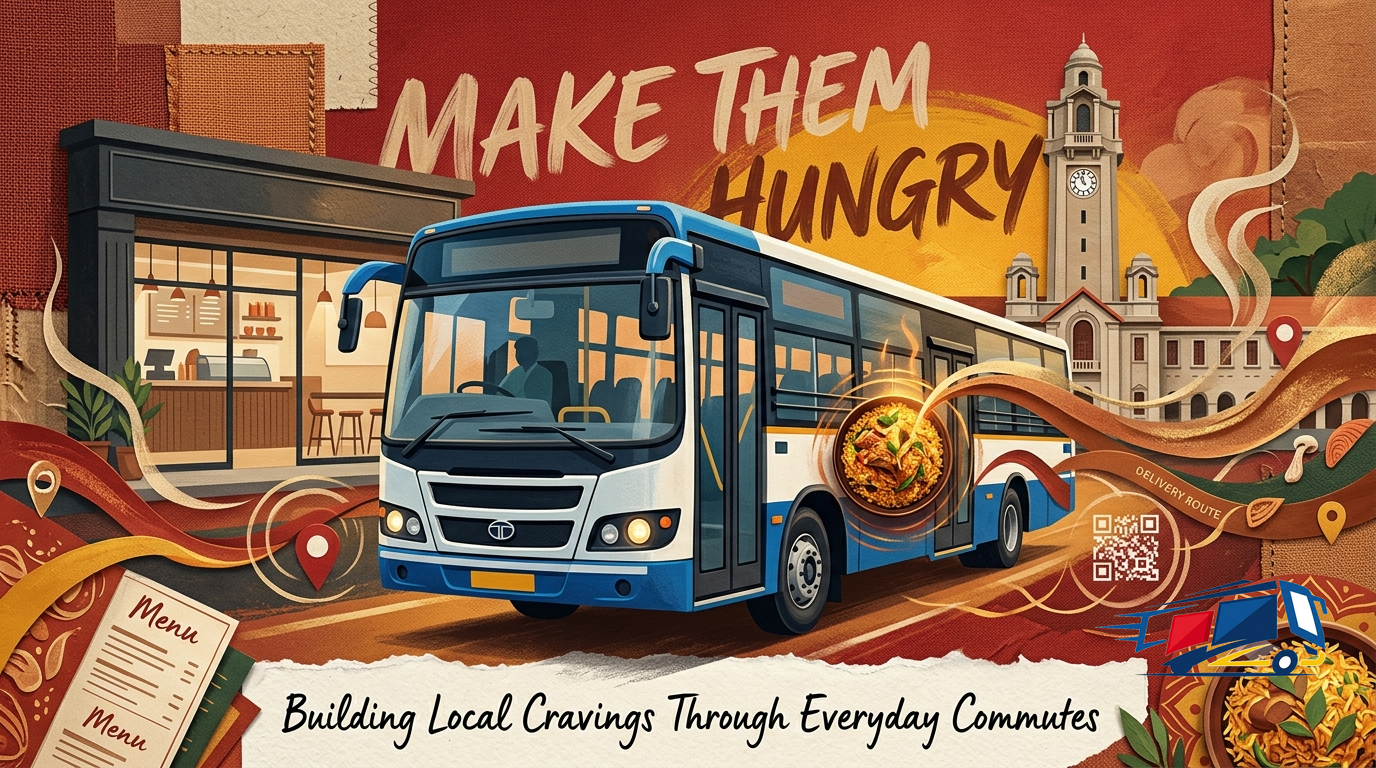
Food is bought on a craving, and that craving is almost always satisfied close by. A restaurant fills tables from its neighbourhood; a cloud kitchen has no tables at all and lives entirely on a small delivery radius. Bus branding fits F&B because it builds appetite and recognition inside that exact radius, so when hunger strikes and the app opens, yours is the name they already know. Here is how transit drives orders.
Key takeaways
- The delivery radius is the market: a kitchen serves roughly 3 to 5 km, so the campaign should own exactly that zone, not the city.
- Build recognition for the app moment: most orders happen on Swiggy or Zomato, so the goal is to be the familiar name a hungry user picks.
- Creative is appetite-led: mouth-watering food and a craving trigger work far harder than a logo and a tagline.
- Point a QR straight to order: a back-panel QR to your app listing or direct order page turns a craving into a tracked order.
- Time it to meal-time dayparts: the buses should be most present when hunger and ordering peak, around lunch and dinner.
The delivery radius is the whole market
No food brand sells to the whole city. A restaurant draws from its neighbourhood and a cloud kitchen delivers within a tight radius, so anyone outside it is wasted reach. The first move is to own that zone completely, and a bus route maps onto it precisely.
Source: hyperlocal food delivery and cloud kitchens operate on a roughly 3 to 5 km delivery radius for freshness and efficiency; marketing is most effective concentrated on that zone, 2026.
Winning the moment the app opens
Here is the chain that matters for food: most orders happen on a delivery app, where dozens of options sit side by side. The brand a hungry user recognises and trusts gets tapped. A bus seen daily in the zone is what builds that recognition before the app even opens.
This is the real job a bus does for a delivery brand. It cannot take the order itself, but it makes yours the familiar, appetising name among a screen of strangers, and familiarity is what wins the tap. It also builds the pull toward your own direct channel, which costs less than every aggregator-commissioned order.
Source: 70 to 90% of cloud-kitchen orders come through aggregator apps where many brands compete; recognition and trust drive selection, and direct orders avoid platform commissions of roughly 20 to 30%, 2026.
Want your brand on Bengaluru's buses?
Get a route plan, format recommendation and pricing, usually within a minute.
Make the creative appetising
Food is sold to the stomach, not the head. The strongest F&B creative triggers a craving: a hero dish shot that makes you hungry, a signature item, a simple order now cue. Skip the corporate look, a bus-side plate of great-looking food is the whole pitch.
| Message | What it does |
|---|---|
| Hero dish photo | Triggers the craving directly |
| Signature / bestseller | Anchors the brand to one crave-able item |
| First-order offer | Lowers the bar to try you |
| New cuisine / menu | Pulls the curious and the bored |
| Order on [app] + QR | Turns the craving into an order |
A bus wrapped with your best dish is a craving on wheels, driving through the exact streets you deliver to, at the hour people are deciding what to eat. That is about as close as outdoor gets to putting your kitchen on the road.
Timing to meal-time dayparts
Food demand is not spread evenly through the day, it clusters around meals. Orders surge at lunch and dinner, with snack and late-night pockets too. The buses are out all day regardless, but the message and any offer should speak to the meal that is coming next.
Source: food ordering concentrates around lunch and dinner dayparts, with secondary snack and late-night demand; aligning message and offers to mealtimes captures more orders, 2026. Illustrative pattern.
An example F&B campaign
Here is the approach made concrete for a cloud kitchen or restaurant growing orders in its zone. The structure is the takeaway, the radius, dishes and offer would be set to your brand.
| Layer | What runs | Job |
|---|---|---|
| Wraps / side panels | Buses on routes inside the delivery radius | Appetite and recognition in the zone |
| Back panels | Hero dish and QR to the app or order page | Turn the craving into a tracked order |
| Office-corridor routes | Buses through workplace areas | Catch the lunch daypart |
| Residential routes | Buses through homes in the zone | Catch the dinner daypart |
- Draw the delivery radius. The 3 to 5 km zone you actually serve, and the routes inside it.
- Lead with the food. A hero dish that triggers a craving, plus a clear order on [app].
- Split by daypart. Office routes for lunch, residential for dinner, across the zone.
- Track with a QR. A back-panel code to your listing or order page, to tie buses to orders.
We will put your kitchen on the road
Tell us your delivery radius, your bestselling dishes and where you want orders, and we will plan the route set that owns your zone, the office corridors for lunch, the residential streets for dinner, wrapped with appetite-led creative and a QR straight to your app listing or order page. We brand the buses across the campaign, weight the routes to your dayparts, and send daily GPS-tagged install photos. You watch the orders and recognition grow. We handle the buses.
Plan your delivery-zone campaign under bus branding in Bengaluru, or see the wider approach in transit advertising.
Frequently Asked Questions
Why use bus branding for a restaurant or cloud kitchen?+
Because food is hyperlocal and craving-driven. A bus builds appetite and recognition inside your delivery zone, so when a hungry person opens an app, yours is the familiar name they pick, and you pull orders toward your own lower-cost channel.
Which routes should a cloud kitchen pick?+
Routes inside your 3 to 5 km delivery radius, nothing beyond it is reachable. Weight office-corridor routes for the lunch daypart and residential routes for dinner, so the buses match where hunger is at each meal.
What should the creative show?+
Food, appetisingly. A hero dish or signature item that triggers a craving beats a logo and tagline. Add a simple order on [app] and a QR, and keep it bold, the plate is the pitch.
How does a bus help if orders happen in an app?+
It wins the recognition that decides the tap. Among a screen of options, the hungry user picks the name they have seen all week on the bus, and the QR can take them straight to your listing or direct order page.
When should the campaign be loudest?+
Around meal dayparts, lunch and dinner are the biggest order windows. The buses run all day, but the message and any offer should speak to the next meal, and routing can lean to offices by day, homes by evening.
How do I measure orders from a bus campaign?+
Use a QR or promo code on the back panel that links to your order page or app listing, and track scans, code redemptions and direct-order lift in your delivery zone during the campaign window.
Bus Branding Glossary
- Full bus branding (wrap)
- A full vehicle wrap covering both sides and the rear of the bus, the highest-impact, most visible format.
- Bus back / rear branding
- Advertising on the rear panel of the bus, in the line of sight of traffic queued behind it at signals and junctions.
- Side panel branding
- Branding on one or both side panels of the bus body, facing pedestrians and parallel traffic along the route.
- Vajra / AC service
- BMTC's premium air-conditioned (Volvo / Vayu Vajra) services, carrying a higher-income commuter set on IT and airport corridors.
- TTMC
- Traffic and Transit Management Centre, a large BMTC bus terminal where many routes start, terminate and interchange.
- Depot
- The BMTC facility where buses are parked, serviced and from which many local routes originate.
- Dwell time
- How long a bus stays in view of a stationary crowd, at a stop, signal or in slow traffic, which lengthens brand exposure.
- Corridor
- A main arterial road (e.g. the Outer Ring Road or Hosur Road) that a bus route runs along, defining who sees the branding.
How to run a BMTC bus branding campaign
Five simple steps from enquiry to a live, tracked campaign on Bengaluru's buses.
- 1
Pick your area & audience
Tell us the Bengaluru area or corridor you want to reach and who you're targeting, IT professionals, shoppers, students or residents.
- 2
Choose a format
Select a format, full bus wrap, rear panel, side panel or premium AC/Vajra service, based on your budget and the impact you want.
- 3
Select routes & bus count
We map the high-frequency routes and stops that cover your audience and recommend how many buses to brand.
- 4
Approve the creative
Share your artwork (or we help design it). We prepare it to BMTC specifications and get the approvals.
- 5
Go live & get proof
We print, wrap and deploy the buses, then share proof of display so you can see your brand on the road.
Bus Branding Formats
Choose how your brand rides, pick the format that fits your goal and budget.
Bus Branding Across Bengaluru
We run BMTC bus branding in every major Bengaluru neighbourhood. Explore more areas:
Outdoor & Transit Advertising Specialists
We plan, design and run BMTC bus branding campaigns across every major Bengaluru corridor, matching brands to the routes, formats and audiences that deliver the most visibility.
Discover More
Bus Branding for Telecom Brands
Why telecom and connectivity brands use bus branding: the mass reach a near-universal market needs, offer-led plan and 5G messaging, and the salience that wins the switch in a low-differentiation category.
Bus Branding for E-Commerce Brands
Why online retail and D2C brands use bus branding: an unskippable real-world break from the saturated feed, the recall paid ads cannot cheaply buy, a sale-event amplifier, and a QR bridge to the app.
Bus Branding for Automobile Dealerships
How bus branding drives showroom visits and test drives for car and bike dealers: reaching buyers on the road, winning the local visit, routing to the showroom, and timing to launches and festive buying.