Combining Bus, Shelter & Digital for a Full-Funnel Campaign
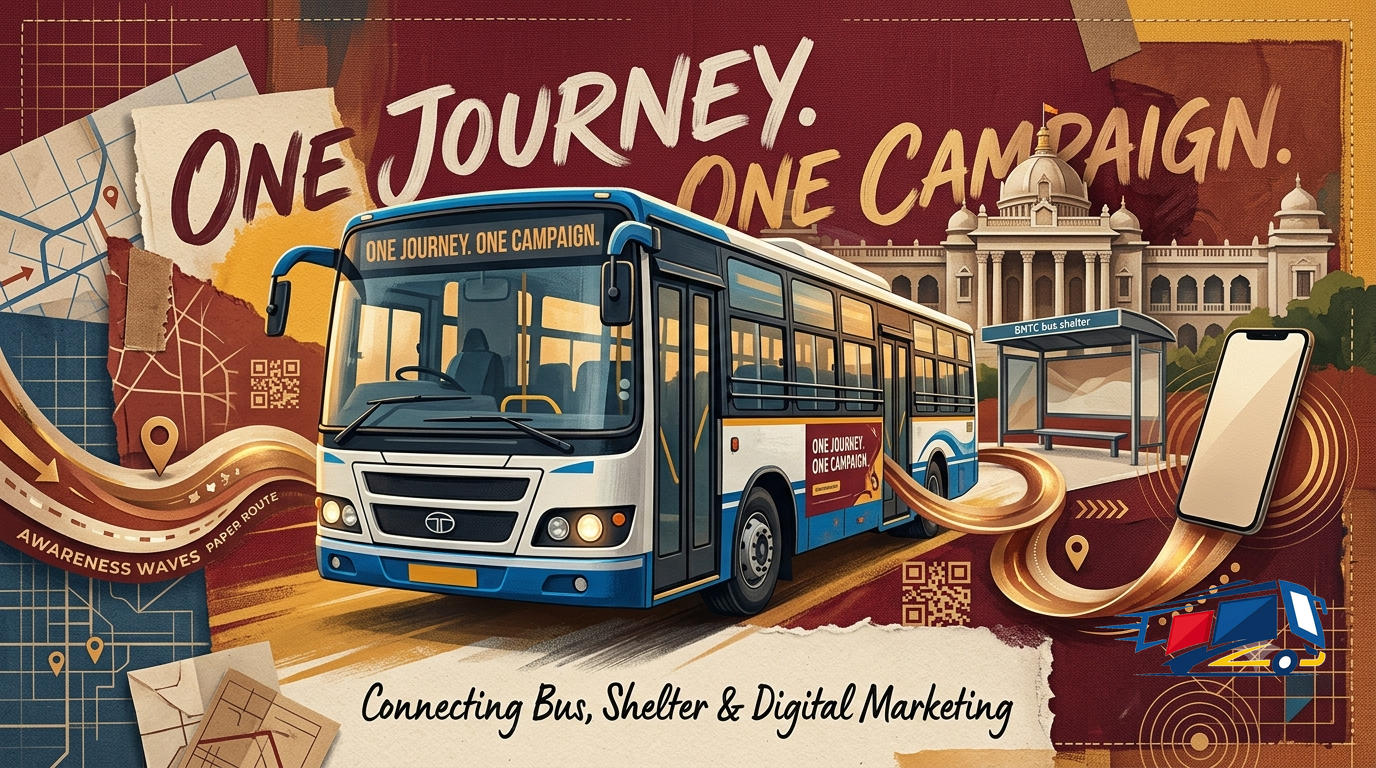
Three channels, three jobs. The bus moves through the city building awareness; the shelter holds a standing, captive audience right at the decision point; digital catches the warmed audience and converts. Used alone, each does part of the work. Stacked in the right order, they cover the whole funnel, from never-heard-of-you to ready-to-buy. Here is how the three fit together.
Key takeaways
- Each channel owns a funnel stage: bus for awareness, shelter for consideration, digital for conversion.
- The shelter's edge is dwell time: people wait 5 to 15 minutes, long enough to read detail, a QR or an offer.
- The bus's edge is movement: it carries the brand across the city to build broad recall the shelter cannot.
- Digital closes the loop: it retargets the people the bus and shelter warmed up, where they actually convert.
- Sequence them: one message, one geography, bus to shelter to digital, so each hands off to the next.
Each channel has a different job
The mistake is treating bus, shelter and digital as three ways to do the same thing. They are not. Each has a distinct strength, and a full-funnel plan uses each for what it alone does best rather than making one channel do everything.
| Channel | Its edge | Best at |
|---|---|---|
| Bus | Mobile, broad, repeated | Awareness across the city |
| [object Object] | Fixed, eye-level, long dwell | Detail at the decision point |
| Digital | Targeted, measurable | Conversion and retargeting |
Mapping the three to the funnel
Lay the three channels over the funnel and the plan designs itself. The bus works the top, the shelter the middle, digital the bottom. Together they walk a stranger from first sight to purchase without a gap.
| Stage | Channel | Job |
|---|---|---|
| Awareness | Bus | Make the city know you exist |
| Consideration | Shelter | Give a waiting audience the detail |
| Conversion | Digital | Capture and convert the warmed |
Want your brand on Bengaluru's buses?
Get a route plan, format recommendation and pricing, usually within a minute.
How they hand off to each other
The magic is in the handoff. Each channel passes the audience to the next, warmer than before. The bus makes you familiar, so the shelter gets read instead of ignored, so the digital ad converts instead of starting cold.
This is why the stack beats the sum of its parts. A cold digital ad works hard; a digital ad to someone who saw your bus all week and read your shelter offer yesterday is almost a reminder. Each layer lowers the resistance for the next.
One channel asks a stranger to buy. Three channels introduce you, make the case, then ask, in that order. The funnel is not a metaphor here, it is the running order of the media.
A worked example plan
Here is the stack made concrete, for a brand launching in a part of the city. Same message, same area, three channels each doing their stage. The numbers are illustrative, the structure is the point.
| Layer | What runs | Funnel job |
|---|---|---|
| Bus | Branded buses on the corridor's routes | Broad awareness, name recall |
| Shelter | Shelter panels at key stops, with a QR / offer | Detail and a reason to act |
| Digital | Geo-targeted social and search in the same area | Retarget, convert, measure |
- One message across all three. Same look and line on bus, shelter and screen, so each reinforces the others.
- One geography. Run all three in the same corridor, so a person meets the brand repeatedly across formats.
- Stagger the weight. Heavier on bus early for awareness, shelter and digital build as the run matures.
- One destination. Bus and shelter point to the same page or number that digital also drives to.
Measuring the stack
A blended plan needs blended measurement: read each layer by its own signal, then look at the whole. The trick is not to credit one channel for what the stack did together.
| Layer | Watch for |
|---|---|
| Bus | Branded-search and recall lift |
| Shelter | QR scans, code use, local enquiries |
| Digital | Clicks, conversions, retargeting performance |
| The whole | Footfall or sales lift vs a control area |
We will build the full stack, not just the buses
If you want more than awareness, we will plan the whole funnel: buses to build your name across the corridor, shelter panels at the stops where people wait and read, and the bridges that feed your digital retargeting. One message, one area, three layers, each doing its job and handing off to the next. Tell us your goal and budget, and we will weight the mix and set up the measurement so you can see the funnel working.
Plan the blended campaign under bus branding in Bengaluru, or see the wider approach in transit advertising.
Frequently Asked Questions
Why combine bus, shelter and digital?+
Because each owns a different funnel stage: the bus builds awareness, the shelter delivers detail to a waiting audience, digital converts. One channel covers part of the journey; together they cover all of it.
What does a bus shelter add that a bus does not?+
Dwell time. A bus is glimpsed for seconds, but people wait 5 to 15 minutes at a shelter, long enough to read detail, scan a QR or note an offer. It carries the considered message a moving bus cannot.
How do the channels work together?+
As a handoff: the bus makes you familiar, so the shelter gets read, so the digital ad converts instead of starting cold. Each layer warms the audience for the next, which is why the stack beats any single channel.
What does a full-funnel plan look like?+
One message and one area across all three: buses on the corridor for awareness, shelter panels at key stops with a QR or offer, and geo-targeted digital in the same area to retarget and convert.
How do I measure a blended campaign?+
By layer and as a whole: recall and search for the bus, scans and enquiries for the shelter, clicks and conversions for digital, and footfall or sales lift vs a control for the stack. Avoid crediting one channel for the combined effect.
Do I need all three?+
Not always, but the more of the funnel you need to cover, the more the stack helps. Pure awareness can lean on buses alone; driving action benefits from adding the shelter's dwell time and digital's conversion.
Bus Branding Glossary
- Full bus branding (wrap)
- A full vehicle wrap covering both sides and the rear of the bus, the highest-impact, most visible format.
- Bus back / rear branding
- Advertising on the rear panel of the bus, in the line of sight of traffic queued behind it at signals and junctions.
- Side panel branding
- Branding on one or both side panels of the bus body, facing pedestrians and parallel traffic along the route.
- Vajra / AC service
- BMTC's premium air-conditioned (Volvo / Vayu Vajra) services, carrying a higher-income commuter set on IT and airport corridors.
- TTMC
- Traffic and Transit Management Centre, a large BMTC bus terminal where many routes start, terminate and interchange.
- Depot
- The BMTC facility where buses are parked, serviced and from which many local routes originate.
- Dwell time
- How long a bus stays in view of a stationary crowd, at a stop, signal or in slow traffic, which lengthens brand exposure.
- Corridor
- A main arterial road (e.g. the Outer Ring Road or Hosur Road) that a bus route runs along, defining who sees the branding.
How to run a BMTC bus branding campaign
Five simple steps from enquiry to a live, tracked campaign on Bengaluru's buses.
- 1
Pick your area & audience
Tell us the Bengaluru area or corridor you want to reach and who you're targeting, IT professionals, shoppers, students or residents.
- 2
Choose a format
Select a format, full bus wrap, rear panel, side panel or premium AC/Vajra service, based on your budget and the impact you want.
- 3
Select routes & bus count
We map the high-frequency routes and stops that cover your audience and recommend how many buses to brand.
- 4
Approve the creative
Share your artwork (or we help design it). We prepare it to BMTC specifications and get the approvals.
- 5
Go live & get proof
We print, wrap and deploy the buses, then share proof of display so you can see your brand on the road.
Bus Branding Formats
Choose how your brand rides, pick the format that fits your goal and budget.
Bus Branding Across Bengaluru
We run BMTC bus branding in every major Bengaluru neighbourhood. Explore more areas:
Outdoor & Transit Advertising Specialists
We plan, design and run BMTC bus branding campaigns across every major Bengaluru corridor, matching brands to the routes, formats and audiences that deliver the most visibility.
Discover More
Bus Branding for Telecom Brands
Why telecom and connectivity brands use bus branding: the mass reach a near-universal market needs, offer-led plan and 5G messaging, and the salience that wins the switch in a low-differentiation category.
Bus Branding for E-Commerce Brands
Why online retail and D2C brands use bus branding: an unskippable real-world break from the saturated feed, the recall paid ads cannot cheaply buy, a sale-event amplifier, and a QR bridge to the app.
Bus Branding for Automobile Dealerships
How bus branding drives showroom visits and test drives for car and bike dealers: reaching buyers on the road, winning the local visit, routing to the showroom, and timing to launches and festive buying.